The history of the Catholic Church in Parsons is directly related to Osage Mission in what is now known as St. Paul, Kansas, the Missouri-Kansas-Texas (M-K-T) railroad, and the townspeople of Ladore, which was a small town located approximately five miles north of Parsons. In 1868, Father Philip Colleton, a Jesuit missionary from Osage Missions established missions throughout southeast Kansas. One of those missions was in what would eventually become the city of Parsons. Reportedly, the first Catholics used the home of Ed Foley as a meeting place. Mr. Foley ran a grocery store in what is now the 1900 block of Main Street. The early years were spent with Father Colleton sharing his time among the various missions, especially the missions in Ladore and Parsons.
When the townspeople of Ladore tried to get more money for their land, the M-K-T railroad made the decision to make Parsons, rather than Ladore the division point and many of the buildings in Ladore were moved to Parsons. This effectively resulted in the demise of Ladore.
The townsite of Parsons was laid out in November of 1870 by Mr. Olney, a civil engineer hired by Robert Stevens, Superintendent of the M-K-T railroad. Parsons was not officially founded until March 8, 1871.
On April 6, 1872, the very Rev. Louis M. Fink bought land in the City of Parsons on which to build a church to serve the Catholics in the new City. Rev. Fink bought Lot 2 of Block 122, which is the southeast corner of what is now known as Central and Gabriel. He paid$150 for the land plus $12.50 in interest on a three year contract with the Parsons Town Company. The first Catholic Congregation was organized by Father Colleton in a small wooden church, which was built by the parishioners. The original church was a plain frame building with a gable roof and a small steeple. The original church membership consisted of about twenty families and the first service in the newly built church was reportedly held on July 1, 1872.
The new church was solemnly blessed and placed under the patronage of St. Patrick by Father John Schoenmakers, one of the key missionaries of Osage Mission, assisted by Father Colleton, on Trinity Sunday, the 8th of June, 1873. Father Colleton continued to serve St. Patrick’s as a mission, sharing his time between the churches in Ladore and Parsons and traveling around the country establishing and visiting new missions. Although the distance between Ladore and Parsons was only five miles, the trips by horseback were very tiring. To make this trip easier, the M-K-T Railroad lent Father Colleton a railroad handcar to travel back and forth. On Sunday, January 16th, 1876, while on his way to say Mass at Parsons, he was seriously injured in an accident while using the handcar. For six months his condition was critical. He then seemed to improve and was apparently on the road to recovery when death took him very suddenly following a hemorrhage on December 1, 1876.
At the death of Father Colleton, Father Joseph Dreason took charge of the church. In June 1879, a beautiful 600 lb. Troy Bell was obtained through O.L. Hall. It arrived in Parsons on a Monday and was placed in the belfry the following Saturday, June 13th.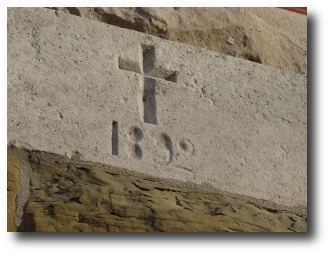 By the spring of 1881, it became obvious that a larger church was needed; so on June 28, 1881, Bishop Fink purchased all of the block between Stevens and Dirr and Central and Lincoln, except for the East 125 feet on the Lincoln side.
The southeast corner of Central and Dirr was selected as the site for the new church, a large wood-frame structure. Legend has it that the small church from Gabriel and Central was moved to this site and became part of the new building.
By August 1881, Father Roos had replaced Father Dreason. The congregation of the little church grew rapidly and by 1882 numbered over 350. The small house on the Central side closest to the church was used as a rectory. The new church was opened in 1883. By 1884, the congregation totaled over 600. In 1882, the land on the Stevens side of the block, at the head of Central, containing the former home of George Reynolds, was opened as a convent by the sisters of Loretto, who had come from their Convent at Osage Mission. A building was constructed at 1816 Dirr, directly behind the convent, and a school was opened in 1883. The tuition was $1.00 per month.
In March 1886, five acres were purchased in the Northwest corner of the City for use as a cemetery. The cost was $100 per acre. Up to this time, the Catholics of Parsons had used the Catholic cemeteries at Ladore and St. Paul. The new cemetery was named Calvary.
In 1887, Kansas Diocesan lines were redrawn and on July 6, 1887, the Wichita Diocese was created, but Southeast Kansas remained in the Leavenworth Diocese. The year 1888 saw Father John Ward, later Bishop of Leavenworth, come to St. Patrick’s as the first diocesan priest to be pastor here.
In 1891, it had become evident that the church at Central and Dirr was no longer adequate to serve the Catholics of Parsons. A new church was planned with over $4,000 being raised for that purpose the first year. An article in the June 30, 1891 Parsons Sun stated, “The Catholics have taken the initiatory steps towards the erection of their new cathedral and are now engaged in removing the convent from its present position to the Southwest corner of their lot.”
Construction started on May 11, 1892. The basement was completed and dedicated on December 18, 1892. A roof was put over the basement and was used for several years for all church activities. Also at this time, a new rectory was constructed just West of the new church at 1819 Stevens, replacing the rectory at 517 -19 North Central. In 1892, the old church at Central and Dirr was converted into a convent for the Sisters of Loretto.
On October 1, 1895, Father N. Neusius (pronounced ‘new wishes’) came to St. Patrick’s replacing Father Ward. Father Neusius continued with the construction of the new church. The cost of the church was $32,000 for the building and contents with $2,000 being spent for the pipe organ. Although these are the correct amounts spent on the church, it is certainly not the true cost. Many men and women of the parish donated thousands of hours of their labor to make the dream of this church a reality.
In 1896, the Sisters of Loretto withdrew from Parsons and the Sisters of St. Joseph took their place. The decision was also made to move the Mother House from Abilene to Parsons. The sisters would now be known as “Sisters of St. Joseph of Parsons, Kansas”. The convent was enlarged to house the new “Sacred Heart Academy”, which opened in September 1896. Only day pupils were enrolled because there were no facilities for boarders.
Apostolic letters, dated July 1, 1897, from Rome definitively set new diocesan boundary lines in Kansas. By the reapportionment, Leavenworth diocese gave up twenty-one counties, fourteen in the Southeastern part of the state to the Wichita diocese, which included Parsons.
In 1899, Mother Bernard moved the Mother House to St. Paul, Kansas, while the sisters continued to serve the Catholics of Parsons.
The completed St. Patrick’s church was dedicated on September 2, 1900. The church building is 58 feet wide and 145 feet long, with a 78-foot transept. The tower is 165 feet tall and the largest bell in the tower weighs 2000 pounds. While the basement walls were constructed of sandstone, this stone was not available when the rest of the church was built, which is why red brick was used. The church was decorated in Roman style, and the stained glass windows were created by the St. Louis Glass Company. At the time of completion, it had a seating capacity of 800. A new organ was purchased for $2,000.
On April 20, 1902, Council 643, Knights of Columbus, was instituted with 65 members. It was the fourth Council to be organized in the State of Kansas.
In 1903, construction of a new school at 1830 Stevens was started under the supervision of Father Neusius. The old school at 1816 Dirr was torn down. A special feature of the “new” St. Patrick’s school was the kindergarten department, which had an attendance of 22 pupils.
A few years later, in 1913, the old church at Central and Dirr, which had served as a convent and academy, was torn down and a new convent constructed at the same location. The cost of the new building was $15,000.
In 1911, the Sisters of St. Joseph started construction of Mercy Hospital in the Northeast corner of town. The hospital opened in 1912. Also, in 1912, the old church at Ladore was ordered sold to the Sisters of St. Joseph by Father Neusius. The building was torn down and the lumber used in the construction of a nurse’s home at Mercy Hospital.
A school of nursing was also established and staffed by the Sisters, opening in 1912 until 1936 and then again from 1943 until 1953.
The January 23, 1915 edition of the Catholic Advance announced, that after a year’s absence because of ill health, Father Neusius would not be able to return to his parish in Parsons.
Father B.J. McKernan came to St. Patrick’s in 1915 to replace Father Neusius. In 1916, Father McKernan moved from the rectory at 1819 Stevens, which Father Ward had built, to 1807-09 Stevens.
In 1924, St. Bernard’s Circle of the Daughters of Isabella was created.
In 1932, a new Catholic cemetery was opened on the South side of Memorial Lawn Cemetery, southwest of Parsons. It was named Mt. Olivet.
Father McKernan, pastor of St. Patrick’s, died in November 1936. Father Gerstenkorn replaced Father McKernan.
Father Albert H. Walsh replaced Father Gerstenkorn in 1938. In 1940 Father J.P Mangen took over as pastor of St. Patrick’s.
On June 5, 1940, Bishop Christian H. Winkelman bought Lots 1 and 3 of Block 120, the southwest corner of Central and Chess. This property was used for the construction of Our Lady of Victory church and school, which was opened on November 3, 1940. This facility was established under St. Patrick’s charge for the spiritual and educational care of the Mexican community in Parsons.
In 1947, Reverend E.I. Gunning returned to Parsons as Pastor of St. Patrick’s church. Our Lady of Victory church and school were closed in 1950. Also in 1950, St. Patrick’s school was torn down and a new school was built on the site of the old school. During construction, grade school classes were held in the basement of St. Patrick’s church and high school classes were held in the recently closed Our Lady of Victory church. The new school included a high school, where students from St. Patrick’s and St. Mary’s attended. Father Gunning also built a new parish rectory in 1950.
The year 1963 saw the closing of Mercy Hospital, ending 50 years of health care for Parsons by the Sisters of St. Joseph.
Father Dennis Dougherty returned to Parsons in 1968 to serve as pastor of St. Patrick’s.
After twenty years of operation, St. Patrick’s High School closed with the ending of the 1971 spring term. St. Mary’s and St. Patrick’s elementary grade school operated as one, and students from the eighth grade would once again attend the public school.
From 1969 to 1981, St. Patrick’s parish was served by Father Peter Finnegan. From 1978 to 1980 an extensive refurbishing program was started and completed. The work entailed repairing the beautiful stained glass windows, a new heating and air conditioning system, painting the interior, new carpeting, an elevator for the elderly and handicapped, new restroom, and bridal room facilities in the basement.
Father Edward Steinberger served St. Patrick’s as pastor from 1981 to 1983.
In 1983, Father Paul Alderman, who was raised in St. Patrick’s parish, returned to Parsons as pastor.
In March 1984, a St. Vincent de Paul Society was established for charity work.
In January 1986, an extensive remodeling program was initiated on the new Parish Hall in the basement of the church. The modern refurbished interior included a large meeting area, new kitchen, updated wedding dressing rooms and restrooms, larger windows and improved access for the handicapped. The great organ in the choir loft was also restored.
In 1988, Fathers Leo and Leon Kerschen were appointed co-pastors of St. Patrick’s and Mary Queen of Peace parishes. During their years as co-pastors, they worked diligently to establish fiscal responsibility by reducing each parish’s debt. In addition, because of changes within the Catholic Church, they also labored to prepare the Catholics of Parsons for the merging of the two parishes into one.
In 1995, the decision was made to close Mary Queen of Peace church and the two parishes merged. Fathers Leo and Leon Kerschen continued to serve the Catholics of Parsons until 1996, when Father Michael J. Schemm became pastor of St. Patrick’s.
In 1997 St. Patrick's celebrated the 125th anniversary of the founding of the parish. To celebrate, there was an all school and parish reunion culminating in a special Mass offered by Bishop Eugene J. Gerber.
Fr. Schemm worked with the parish to re-open the 6th, 7th, and 8th grades at St. Patrick's Catholic School. Our first class to finish 8th grade at St. Patrick's graduated in 2002. Fr. Schemm served the parish until his transfer in 2001, when Fr. Robert Wachter took over as pastor.
Fr. Wachter began an aggressive savings program to lay the foundation to do some much needed up keeping in the church. He served the parish until his transfer in 2005.
Fr. Jason Borkenhagen began serving as Pastor in 2005. Under his direction in the fall of 2005, plans were made for Perpetual Adoration of the Most Blessed Sacrament . Adoration was held first in the Adoration Chapel in the church basement. The parish began planning and constructing an Adoration Chapel building in 2016. It was completed and opened on Dec. 31, 2017.
Planning for extensive renovations of the inside of the church was begun in 2006 and the project was completed in 2008. Everyone agreed that the result was stunning.
In 2008 the parish celebrated the 125th anniversary of the school with an all-school alumni dinner in the school gym
Father Curtis L. Robertson came as Pastor in 2017. He saw our parish through the COVID-19 pandemic and a major renovation project. In the spring of 2020, COVID-19 threatened to close down churches and schools across the nation. St. Patrick Catholic School went remote for the remainder of the 2020 school year, yet Mass was continued in-person and streamed online throughout the pandemic.
In the fall of 2020, an inspection was performed by engineers on the church roof. It was determined that the condition of the roof framing was of grave concern and was recommended that the church be immediately closed to the public until formal repairs could be made. Mass services were moved to the St. Patrick Catholic School gym and the doors of the church were closed on November 21st, 2020. Feasibility studies for a Capital Campaign were completed and a Capital Campaign Committee was formed to work in collaboration with Betty Johnson & Associates to fundraise for the Capital Campaign. The campaign launched with the goal of 4.3 Million dollars raised to cover the bid for renovations and the repairs began in the summer of 2022.
From 2022-2023, Dondlinger Construction of Wichita, KS performed the extensive repairs and renovations to our church. Great care was taken to preserve the original beauty of the Church. The project was incredibly vast in its scope and included, but was not limited to: replacement of the entire roof, fixing the interior roof plaster, removing and reinstalling electrical systems within the roof, reinforcement/rebuilding of the bell tower, replacing gable vent louvres, wall reinforcement, and repairs of the masonry joints of the entire Church among many other repairs that were deemed necessary along the way.
In the spring of 2023, the 150th Anniversary parish celebration was coupled with an All-School Reunion over St. Patrick's Day weekend. A commemorative coin was developed for the special occasion and the Inaugural Edition of The Lorica, a bi-annual alumni newsletter for graduates of St. Patrick high and grade schools, St. Mary's, and Our Lady of Victory school graduates, was printed. Many attended the special event.
June 3rd, 2023 construction was completed and the doors reopened to our newly renovated Church after over 2.5 years celebrating Mass in the school gym.
In July of 2024, Father Nicholaus Jurgensmeyer became pastor of SPCC.
History of St. Mary’s Catholic Church - Parsons, Kansas
 In 1909, additional responsibility came when Bishop Hennessy established St. Mary’s parish on the West side of Parsons to care for the parishioners living a long distance from St. Patrick’s church. Father Neusius, pastor of St. Patrick’s , was charged with the purchase of property for the new church, buying the block at the corner of Crawford and Thirtieth streets.
The cornerstone of the new St. Mary’s was laid in the fall of the year and the following summer, Bishop Hennessy dedicated the new church. St. Mary’s was, at the time, in the middle of a prairie and it was necessary to cross a foot bridge when the cornerstone was laid in December 1909. Father Hayden, assistant at St. Patrick’s said Mass in the new edifice.
Reverend Father P. McCullough was established as pastor of the new church in 1911, coming from Cherryvale. The new parish was facing a large debt and it was up to the struggling pastor and parishioners to raise large funds. A temporary residence was constructed within six months.
The church debt paid, the parishioners began to think of a new school and in 1912 the foundation was laid. In 1913, the first half of the two-story structure was completed and formally opened September 22. The Sisters of St. Joseph were placed in charge and 34 students enrolled the first year.
In 1923, a church bell tower and vestibule were added and bells were purchased for St. Mary’s church at a cost of $2,350. By 1925, St. Mary’s school was doubled – a basement and heating plant plus inside toilets were installed and a second floor was added. Total cost of this addition was $13,432.
In 1928, Rev. Dr. J.W. Maher was appointed pastor of St. Mary’s. A noted public speaker, he served until his death in September 1936. Father Thomas Maher replaced his brother as pastor of St. Mary’s.
With Father Hertel’s arrival in 1953, it was determined that all the buildings had deteriorated to the extent that they needed to be replaced and an extensive building program was undertaken. A new rectory was completed in 1953, and a new grade school was completed in 1957.
In 1963, a new church for St. Mary’s was built and dedicated.
In 1964, Father Joseph Fischer replaced Father Hertel as pastor of St. Mary’s
In 1968, Father James Spexarth took over as pastor of St. Mary’s.
In 1973, Father Francis Cox was appointed pastor of St. Mary’s.
Father Alonzo R. Smithhisler was appointed pastor of St. Mary’s in 1983.
On December 9, 1984, St. Mary’s Parish was rededicated as Mary Queen of Peace parish.
Father John S. Zich took over as pastor of Mary Queen of Peace parish in 1986.
In 1988 Father's Leo and Leon Kerschen co-pastored Mary Queen of Peace and St. Patrick Catholic Church's parishes.
Mary Queen of Peace Parish was closed in 1995 and merged with St. Patrick Catholic Church's parish.